Afkar 9 Fikra is a new zine coming out of Liverpool for Arabs in the diaspora and I was lucky to be part of the first issue, which launched with a whole markers market by Arabs! I unfortunately wasn’t able to make it, but followed it on my socials.
This poem, Hide and Seek, I wrote many years ago now, and I’m pleased that it’s finally seen the light of publication. If you haven’t, check out the zine, support artists and buy a copy — it’s full of great new writing and art.
Hide and Seek
A mound: an ancestor sleeps. I climb up. I slide down. I climb up like a kid who mounts dad as dad bows down to God. I kiss the warmth with lips my mother gave me, pull away with the tang of oil.
A flat on the 14th floor in rainy London Town. Or, perhaps it is the 17th floor. A flat devoid of roots so its place hardly matters. Inside, a toddler maniacally shreds an Oxford dictionary as if rejecting a prophecy.
A grave in Winchester: A boy trips over a headstone in this English city of dead. “You’ve angered a ghost,” (says a schoolmate prophet) “it will haunt you seven years.” Soon after, we move to Bahrain. Britain latched to my gums.
A flat east of Bani Jamra’s graveyard. المگبرة حديقتنا Its roots spread deep. Behind a half-built house, abandoned, we pull steel from the foundations like swords from stone, I draw Excalibur, Jameel wields ذو الفقار. Hide and seek trains a generation to evade arrest. A highway paves over my oral history, makes a ghetto of a mourning house. A tyre burns at the intersection of my grandmother’s village and the city. الحرايگ بخور ديرتنا There is rot in the air.
Jameel is handsome in prison: he is exceptional at the game but in the end the seeker wins. Now he is a prayer.
A certain Captain Robert Taylor of the East India Company: He reports that the water is too brackish for any but the indigenous. Does it occur to him we have not invited him in for a drink?
A one-way ticket to Heathrow: seven years have passed. The rules of hide and seek have changed. I stitch my mother’s accent to the roof of my mouth, perform the Queen’s English.
An empty crater: Once it pooled water, then it burbled oil. Lately, it was a grave. I tumble down the chapped slopes like a child who mounts dad mid-bow and slips as dad rises.
A father who has shouldered a burden for a lifetime collapses.
A crater is filled. Landfill. A prison is filled. Landfill.
In Manchester, the cold seeps between my toes and sighs up my joints. An unemployed dialect gasps like a tyre fire.
The Legend of The Looms Ali Al-Jamri | Blackburn Museum and Art Gallery | 1 February – 8 March 2025 | Free Commissioned by the Arab British Centre as part of As We Are, Might Have Been, and Could Be, in partnership with British Textile Biennial
Working in film for the first time, Ali Al-Jamri’s commission titled The Legend of The Looms is an installation of poetry, film and textiles exploring shared revolutionary histories through handloom weaving. It features a filmed narrative debate poem between two ghostly handloom weavers: one from the North West, where weavers were critical in working class movements before, during and after the Peterloo Massacre of 1819; the other from Bahrain, where weaving communities played vital roles in reform movements. In this dramatised performance, the ghostly weavers spar over whose life was harder, whose struggles were fiercer, whose folk poetry better, until they find common ground and friendship. Filmed with the weavers of Al-Jamri’s own family in Bahrain, and in Rossendale Valley, at a historic weaver’s cottage in Rawtenstall, the piece delicately dances between place, fact and folklore, creating a new myth that explores how people of the diaspora can relate to an unlikely new landscape through the interconnectivity of oppressions, craft, and mortality. The film is exhibited in installation format with the textiles featured in the film, for which Al-Jamri is working with renowned Manchester-based textile artist Ibukun Baldwin.
The film installation will be exhibited at Blackburn Museum, with the British Textile Biennial, from 1 February – 8 March. This work is supported by Arts Council England and The Freelands Foundation.
The following poem was first published by Manchester City of Literature on 18 Dec 2024, the International Day of the Arabic Language. The Arabic text follows the English. You can read it along with City of Literature’s statement on the occasion here.
النص العربي يتابع النص الانجليزي
Crisis of Humanity
“The nightmare in Gaza is more than a humanitarian crisis. It is a crisis of humanity.” — Antonio Guterres, UN Secretary General.
If I ask you to imagine the number, you’ll lose count before you begin— How can you hold the scale of the crime when imagination’s wings fall from the sky? It’s difficult to picture this beautiful child, his infant sister, his auntie, uncle, cousins and neighbours— the neighbourhood kids, the neighbourhood football team, their rivals, their fans, the doctors and teachers, the mothers and fathers, the dreams and the dreams— the pen-marked name on the back of the hand screams “Property of a Wonderful Human” but cannot express the dreams of this wonderful human. It’s tough on your simple imagination to sketch a fragment of this crime.
In the safety of Manchester we celebrate the founding of the radical city. Our playground is the Peterloo Massacre, when the People massed behind the chant of “Liberty or Death!” and the slogan changed its symbolic clothes for a funeral dress. It’s easy to imagine the sixteen murdered in a distant century, but who knows the names of Peterloo’s fallen today, save for the historian behind an archive’s closed doors? As Peterloo’s eighteen witnesses pass from our memory, we find ourselves trying to hold onto today’s seven hundred. Yet the seven hundred are the witnesses of just one day and the list of all their names is not a tenth of all those lost.
I walk the path of Peterloo with my people demanding our state do the smallest thing: Ceasefire now! Ceasefire now! Ceasefire now! I count my steps and with every seven hundred I stop to read the Fatiha.
We do not forget your humanity, Gaza.
In my moment with the dead, Shelley knocks at my heart’s door reciting this city’s mythic foundations:
Rise like Lions after slumber In unvanquishable number, Shake your chains to earth like dew Which in sleep had fallen on you — Ye are many — they are few.
I open the door and behind Shelley enters Abu’l Qassim Al-Shaabi, reciting:
Across the Universe it is declared: Ambition is the soul’s triumph and Life’s blazing fire, When the People speak their spirit’s ambition, Destiny must bow to their desire! Then Al-Shaabi calls over Samih Al-Qassim to my heart’s courtyard and that titan of resistance recites his wisdom:
From the window of my small cell I can see your large cell.
Myself, I cling to these powerful conclusions with which each friend of mine has parted. I’ll kindle that flame in me as a prayer or a candle, kept alight for the departed.
The Masque of Anarchy, Percy Shelley The Desire of Life, Abu Al-Qassim Al-Shabbi, trans. Ali Al-Jamri End of a Discussion With a Jailor, Samih Al-Qassim, trans. Abdullah al-Udhari
محنة الإنسانية
“إن الكابوس الذي تعاني منه غزة أكثر من مجرد أزمة إنسانية. إنه محنة الإنسانية”. أنطونيو غوتيريس، الأمين العام للأمم المتحدة
لو طلبتُ منك تخَيُّل رقمٍ ستفقدُ الحسبة قبل أن تبدأ
كيف يمكنك أن تحتمل حجم الجريمة وأجنحة الخيال تهوي من السماء؟
صعب أن تتخيل هذا الطفل الجميل وأخته الرضيعة وعمّته وعمّه وبنات عمته والجيران وأولاد الحيّ وفريق كرة قدم الحيّ منافسيهم ومشجعيهم والأساتذة والأطباء والأمهات والآباء والأحلام والأحلام – الاسم مكتوبٌ على ظاهر اليد كالوشم يصرخ “ملكيةُ إنسانٍ جميل” ولا يدلّ على أحلام هذا الإنسان الجميل
صعب على خيالك البسيط أن يرسم جزءاً من لوحة هذه الجريمة
في أمان مدينة مانشستر نفرح بخرافة خلق المدينة ملعبنا هو مذبحة بيترلو، حين احتشد الشعب خلف هتافات “الحرية أو الموت” فتبدّلت ملابس الشعار من الرمزية إلى الجنائزية
من السهل علينا تخيّل الثمانية عشر قتيلاً في قرن بعيد لكن من يعرف أسماء شهداء بيترلو اليوم سوى المؤرّخين وراء أبواب الأرشيف المغلقة؟ وبينما شمعة شهداء بيترلو تنضمر من ذاكرتنا نأمل أن نحفظ أسماء الشهداء السبعمائة لكن السبعمائة هم شهود يوم واحد وقائمة أسمائهم لا تَصِلُ عُشر من فقدناهم
أسير على طريق بيترلو مع الشعب ونطالب من “النظام” بأبسط شيء
وقف إطلاق النار وقف إطلاق النار وقف إطلاق النار
أعدُّ خطواتي وبعد كل سبعمائة خطوة أقف لأقرأ عليهم الفاتحة
لا ننسى إنسانيتكِ يا غزّة
في لحظتي مع الفقدان يدق الشاعر شيلي باب القلب قارئاً أسطورة المدينة التي خَلَّدها
هُبوا كآسادٍ بعد الرُقاد في جُموعٍ ليست تُقهر اِنفُضوا الأغلالَ كما تَنفِضُون ندىً تساقطَ عليكمُ في نومكم أنتمُ الأكثرون .. وهمُ الأقلون!
أفتح الباب لـ شيلي ويدخل وراءه أبو القاسم الشابي، وينشد
أعلنَ في الكونِ أنَّ الطموحَ لهيبُ الحياة وروحُ الظَّفر إذا طمحت للحياة النفوسُ فلا بدَّ أن يستجيب القدر!
ثم يستدعي الشابي سميح القاسم إلى ديوان القلب ليذكرني بحكمته
من كوة زنزانتي الصغرى أبصر زنزانتك الكبرى
أما أنا، فأتشبث بخلاصة كلماتهم السامقة
التي رحل عنها كل أصدقائي سأُشعل ذلك الشرر فيّ كالدعاء أو شمعةٍ تُضيءُ ذكرى الشهداء.
قناع الفوضى، بيرسي شيلي، ترجمة ماجد الحيدر إرادة الحياة، أبو القاسم الشابي خاتمة النقاش مع سجان، سميح القاسم
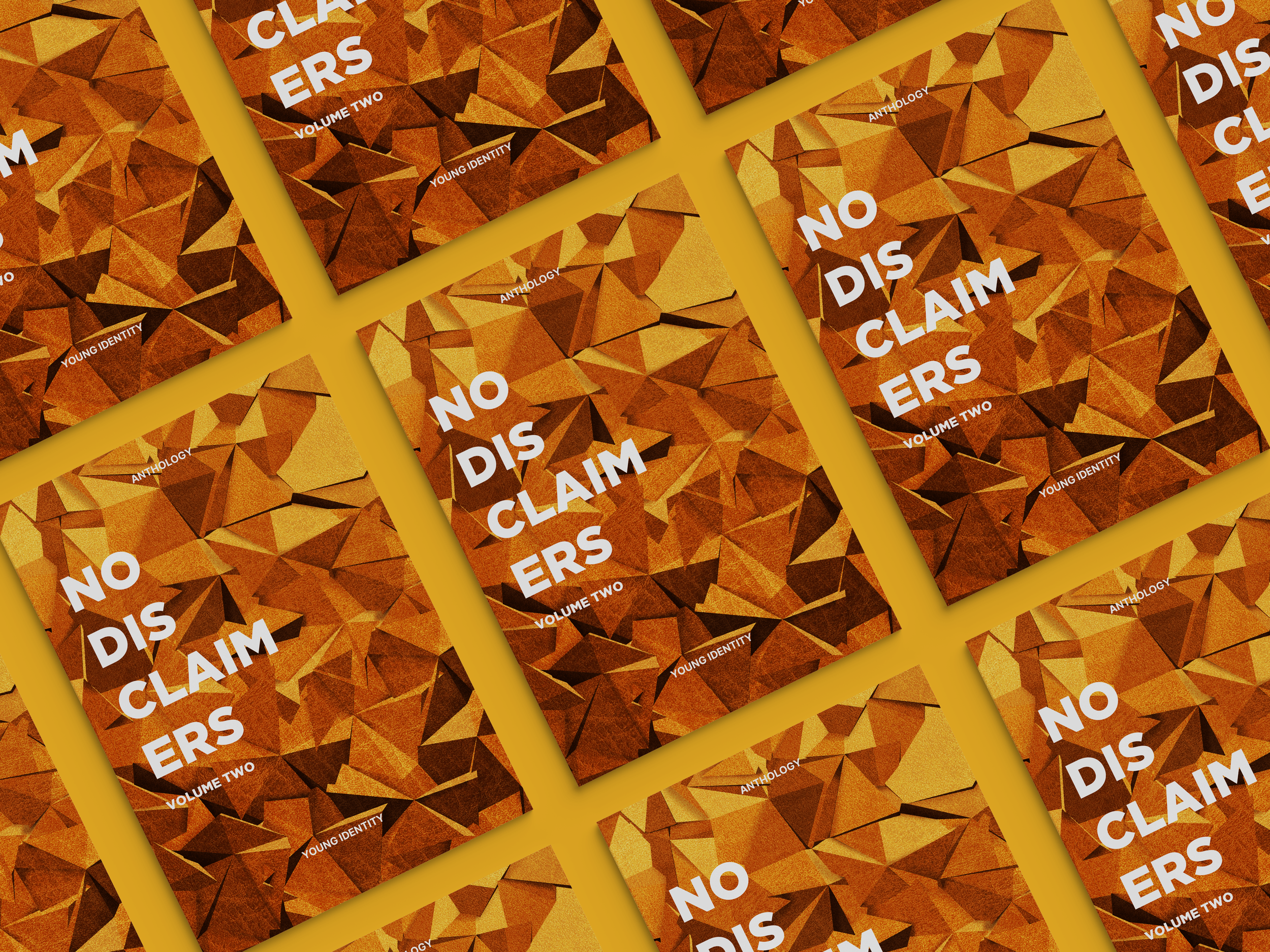
Young Identity’s latest collection is out: No Disclaimers Volume 2. I’m in it, and you can buy it here: https://www.youngidentity.org/shop
YI’s book features two of my poems. Asked for poems about loss, I submitted two related to my the losing my grandfathers. The first one, Now Loading, is about my own personal experience when my grandfather Sheikh Abdulamir Al-Jamri died in December 2006. I was 15 and a useless ancillary in the family grief of his funeral. My grandfather’s funeral was probably the largest single funeral in recent memory in Bahrain. He had been the leading figure in the 1990s struggle for democracy, and a uniting force who was respected across society, from the religious, secular, and governmental sections. Everyone turned out to pay their respects, and his death was as much a national event as a family one. Understandably, perhaps, my own individual sorrow was lost in the wider picture. The poem does not do justice for him or his legacy – but it doesn’t set out to, really. It is about me, stuck at home, dealing with my own loss, trying to lose myself in the world of The Elder Scrolls IV: Oblivion – a game whose plot is spurred by the death of an emperor. Our computer was outdated and could barely run it, and in between every town, dungeon and field, the long loading times forced me to consider what I was trying to close myself from.
The second poem, In the Footsteps of my Forebears, is a love letter to my maternal family’s home of Jidhafs. Due to many reasons, the pandemic amongst them, I went many years without visiting Bahrain. In that time, I grew a lot; came to understand and value family and personal histories more, in that way I think happens to a lot of people as we move from our 20s into our 30s. Now older and wiser, I was eager to spend time with my grandfather. But, in 2022, three days before I was due to visit, my grandfather Hajji Saleh Al-Qassab suffered a stroke. He passed away shortly after I returned to the UK. I’m glad that I was able to spend time with him in hospital, but sorrowful for all the lost opportunity. One of my fondest childhood memories of him was accompanying him to the Al-Musharraf mosque in Jidhafs, and it’s around that memory, and my own changing perceptions of Jidhafs and Bahrain (Awal), that this poem is borne from. And, in placing myself in Jidhafs and letting its rich history breathe through my pen, I was able to spend time with my grandfather in a way that life’s course prevented.
Now Loading
My world is cloistered in the inches of a CRT. Blue. A cell, a tunnel, a hope: Tamriel. Then, the emperor has fallen. His voice releases me of a history I have not yet grasped. His Picard intonations, so unlike the gasping of a stroke, spittle foaming like the waves washing the feet of Abu Subh beach.
Tip: Save often. The Planes of Oblivion are a dangerous realm.
My world is Tamriel, cloistered blue in a cell. The inches of the past, a tunnelling voice, so unlike the feet that wash Abu Subh beach, foaming, intoning, his Picard spittle spraying over waves, I gasp for release, the emperor has fallen, grasping the CRT’s hope. The avatar fumbles for the quickload. Not yet.
Tip: Your agility affects how often you are staggered or knocked back.
Considering how it rained, flooded, rained. I do not have a quicksave or a compass. Like the avatar following the emperor down hope’s tunnel, I never questioned your wisdom until it was gone. How obvious now, the pathetic fallacy. Past Saar, a procession down a cathartic path autosaves. Filling the grave, washing the feet that fill the yard.
Tip: Beware, the death of the dreamer means the death of those who share his dream.
Abu Jameel lies in a save state I cannot reload. I did not enter Tamriel until I knew hope was gone. How pathetic. That night, washing past Saar, a procession arrives at the yard. The grave, filling, rain beats the avatar following the emperor down. A tunnel is filled. Intonations foam blue. The voice, a past I must now know. I release a gasp. Foaming with the washing of the feet. Flooding blue. Grasping:
He died at 4.30 AM, 18-12-06. My processor churns a loading screen, stuck.
In the Footsteps of My Forebears
In memory of my grandfather Hajji Saleh Mahdi Al-Qassab, who passed away on 18 August 2022 before I could share this poem with him.
I: The Grandson
Following in your footsteps, my little feet catch, under the scuffed leather of my sandals, the dust kicked up along your winding path: across the road where pick-ups cough, up little hills, down narrow ways and past a thin cat’s hiss to where the market meets the lingering smell of fish. Along this road, grey and beige, looms Al-Musharraf, glimmering green and draped in black, there we wash, there we pray, there you find your bliss. I sit in the radiance of your voice and hearing the words you say, I sense a deeper love in them, wonder what their meaning is.
The grandson sits at one end of the hall, his grandfather along the opposite wall. At his place just by the minbar, he sits and opens his book to read and as he adjusts the mic, he thinks of all the sights this little boy’s eyes have missed.
II: The Grandfather
My feet still weave us through the gardens, orchards and the springs, up the hill (twice flattened now), then down black curbs again, to sink in earth that feed date palms from whose tall necks the birdsong streams. Go up the bustling market path: it’s where Awal’s patchwork wove to barter by the water flows that fed our town’s fruitful groves— —And from the square, the jam’i looms! When we enter Al-Musharraf, I wish that I could tell you, child, the many things you’ve missed. I take my seat to read the Karbala epic and hope that through my intoned voice you’ll glimpse Jidhafs as I recall, as it, to me, still is.
The grandfather grows in the town he knows, his grandson leaves for the end of the globe. By the time he knows to love this path, it’s by himself that he must go.
III: The Grandson
My grown-up feet follow the prints of you who came before, past Luza’s graves and Imam’s too, to the Madrasa of Sheikh Dawood where I still see the Dilmun Stone that Victorian men passing through nicked from beneath its descendants’ feet. The winding path leads me into Fareeg Sultani where the men of state once built their homes made safe and strong with seradeeb, the basements which, in times of war, would prove our people’s sanctuaries. I crane my neck to view the hills that shade the children in the springs, their laughter splashing like a lute, the background to the market’s buzz! There’s the spot your Baba Mahdi sat and ground and brewed coffee, where for the price of just 5 fils you’d learn this at our forebears’ feet:
How Jidhafs was the beating heart from where Awal’s arteries spread to feed the people’s souls and trees and made this land of countless palms a Garden of Eden. Along the path and up the steps, in hallowed Al-Musharraf, my footsteps sprout these memories nourished by your sonorous voice, such that the tapestries, black and green, remind us not of Karbala’s epic but of Jidhafs, your town as once it was, where ‘was’, so vividly remembered, still ‘is’.
It’s been a good first half of the year. 2023 has not been quite as busy as 2022, but that was intentional – after three very full years with nearly constant activity since 2020, when I was part of BBC Words First and laying the groundwork for Between Two Islands, I’ve needed some downtime. Though this list will be a bit shorter than previous ones – the roundup is focused on published works and completed projects – there have been a lot of projects I’ve been pushing forward in the background here, ones which will hopefully bear fruit in the not too distant future.
Manchester Multilingual City Poet
My post as one of Manchester’s three inaugural city poets was renewed for 2023, alongside Jova Bagioli-Reyes and Anjum Malik. You can see me speaking about this at the start of the International Mother Languages Festival at the Central Library here. Al-Usra wal-Sufra (see here) was exhibited at the Central Library too! There is a lot more coming from the city poets this coming year, but that will be in the autumn.
‘On the Rain’s Bow’ – ArabLit Quarterly
In April, ArabLit Quarterly published its latest issue – RAIN. I collab’d with Zainab Almahdi (long time collaborator and editor friend who made the Return of Um Hmaar comic for ALQ’s FOLK issue) to create this short little comic for the RAIN issue. I translated a selection of children’s rhymes about rain and storyboarded the comic which Zainab brought to life so vividly. The children’s rhymes all come from the book Min Turath Sha’ab al-Bahrayn by Mulla Muhammad Ali Al-Nasiri, the poet and local historian who captured so much of Baharna traditions in his books. You can see a snippet here and buy the issue to see the full comic.
Articles and Interviews
I’ve had several pieces published recently related to and beyond the realm of pure poetry.
In March, I published a piece on WorldKidLit Blog about bringing multilingualism and translation into the English classroom. I largely keep my work as a teacher separate from my work as a poet, at least on digital platforms, but it’s frequently impossible – being an English teacher always gives me opportunities to be a poet amongst the astounding young creatives I teach. Anyway, this blog – and I have to thank Ruth Ahmadzai Kemp for editing the original, which was an academic essay towards my Post-Graduate Diploma in Education, into the piece you see here – is a reflection on how to bring translation into the English classroom.
In April, Modern Poetry in Translation published my interview with poet/translator duo Najwan Darwish and Kareem James Abu-Zeid; I really can say nothing more than set aside 20 minutes and read this! Both Najwan and Kareem are such great speakers, and the interview shimmers with their insights and reflections on literature, art and the process of translation.
In June, I published An Island Without a Sea: Bahrain Odyssey with The Markaz Review, and it is honestly my favourite single thing I’ve written this year. The piece is a sweeping journey across 5,000 years of history and poetry, beginning in ancient Dilmun and ending in the year 2123 in a dystopian vision of the ruined remains of Bahrain’s environment. I feel incredibly strongly about the Bahraini landscape and the unwise destruction of it that we have witnessed in my lifetime.
The piece ends with a poem, which I had originally written in Arabic and translated into English: Iftar at the Great Shoals City, 2123. Have a read on Markaz’s website and enjoy.
Other things…
This little list doesn’t quite do justice to the last six months! In the meantime, I’ve also completed my Post-Graduate Diploma of Education, which brings two (and in a real way, three) years of teacher training to an end… hopefully, freeing my time up for newer projects. There is also a very cool poetry/photography project which is pending publication. I have also completed a major redraft of my novel (which I hope to start talking about more someday SOON), written a long biography of my poet ancestor Mulla Atiyya Al-Jamri (20,000 words and going, written in the apex of a winter’s gloom) and started on several new translations. And I have weathered the disappointment of many, many rejections for my poetry in magazines. I have, in short, been keeping busy, and I hope that gives me more to share with everyone soon.
It has been another busy 6 months. As with my last roundup, my quiet is usually due to teaching (they said it’d quieten down after the first year… hmm) but here are some highlights. Most of this has been performance-heavy this past half-year. My Bio page includes a full list of all publications.
Manchester Multilingual City Poet
I continued in this role — performing in October alongside Jova Bagioli Reyes and Anjum Malik, we showcased some of our work each and translations of Jova’s stunning poem, about the streets’ memories… there’ll be more to say about this in the new year I expect.
Pear Project
At new Longsight Arts Centre, I was one of the resident artists for its inaugural Pear Project. My work included a narrative debate poem between a pear and an apple (audio only at present); and the translation of a praise poem for pears by the Mamluke-era Egyptian poet Dhafir al-Haddad. I also did intergenerational workshops with the community, and worked with local illumination artist Maryam Hussain to bring the praise poem to new life. This was a fantastic local project — a lot of the results are very ‘you had to be there’, physically present in the moment stuff. But as well as being on my instagram, it’ll find new homes in the future too.
Cabaret for Freedom
I performed my poem ‘In the Footsteps of my Forebears’, which is dedicated to my grandfather Hajji Saleh al-Qassab, who passed away this summer, in the Cabaret for Freedom this October past.
Your Choice: KS5
I’ve contributed a lesson for the PSHE textbook Your Choice by Harper Collins which is out now – if you’re an A-Level teacher, check it out. I speak about racism and orientalism in my chapter!
Time of Reflection
For the most part, I’ve been purposefully winding down a lot of activities to give myself a rest. If you look at my previous roundups, you can see just how much I’ve done in the 18 months previous. Capitalism would tell us that this past 6 months is a loss, you should neve slow down… And that’s foolish and stupid. There are some things that haven’t made it into the above – things that will bear fruit (though perhaps not pears) in 2023, so stay tuned. 🙂
This article was originally published in ArabLit Quarterly: FOLK, in December 2021. The issue (and all the back catalogue up to the latest issue) can be purchased on Gumroad. A year since publication, and on the International Day for the Arabic Language, I thought it time to publish here for wider reading. This piece was an absolute pleasure to write, weaving family history, national history and folk poetry into one wider story. I hope you enjoy. ALQ remains the best way to read it and I highly recommend you purchase a copy of any issue – pdf, ebook or physical – if you enjoy this read. – Ali.
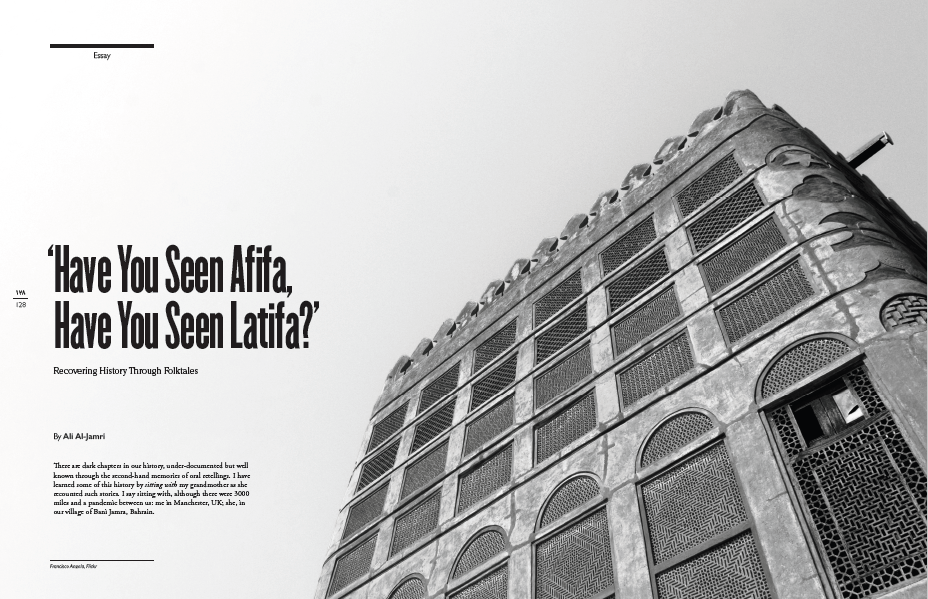
There are dark chapters in our history, under-documented but well known through the second-hand memories of oral retellings. I have learned some of this history by sitting with my grandmother as she recounted such stories. I say sitting with, although there were 3000 miles and a pandemic between us: me in Manchester, UK; she, in our village of Bani Jamra, Bahrain.
But through the mirrored screen of a smartphone, I did sit with her, and we talked for hours. The present pandemic receded as she recalled the past with me. “We repeated these words, but we never thought about their meaning,” she said between stories, “What did we know?”
Our family holds a strong oral knowledge of the difficulty of village life. Our village, Bani Jamra, lies on the northwest coast of Bahrain. Our collective memory is enhanced by the good fortune of having multiple poets in our lineage, particularly through my Granny Zahra’s paternal line. Memory, after all, is one of the main currencies of poets. And through these poems and stories, many memories are preserved from the time of serfdom, which our forebears lived through, and which ended less than a century ago, in 1923.
I already knew the stories of our male ancestors. There are the sons of Abdulrasool, whose many debts were used as a pretext by fidawis—the local lord’s thugs—to attack and arrest them. One son, Ali, fled with his family to Basra, while his elder brother Muhammad was dragged off to jail. In turn, Muhammad’s son Mansoor convinced the jailors to let him take his father’s place and serve the jail time. (Post-Publication addition: Both brothers, Ali and Muhammad, are ancestors of mine — Mansoor, my direct paternal ancestor, was father to my late grandfather Sheikh Abdulamir Al-Jamri)
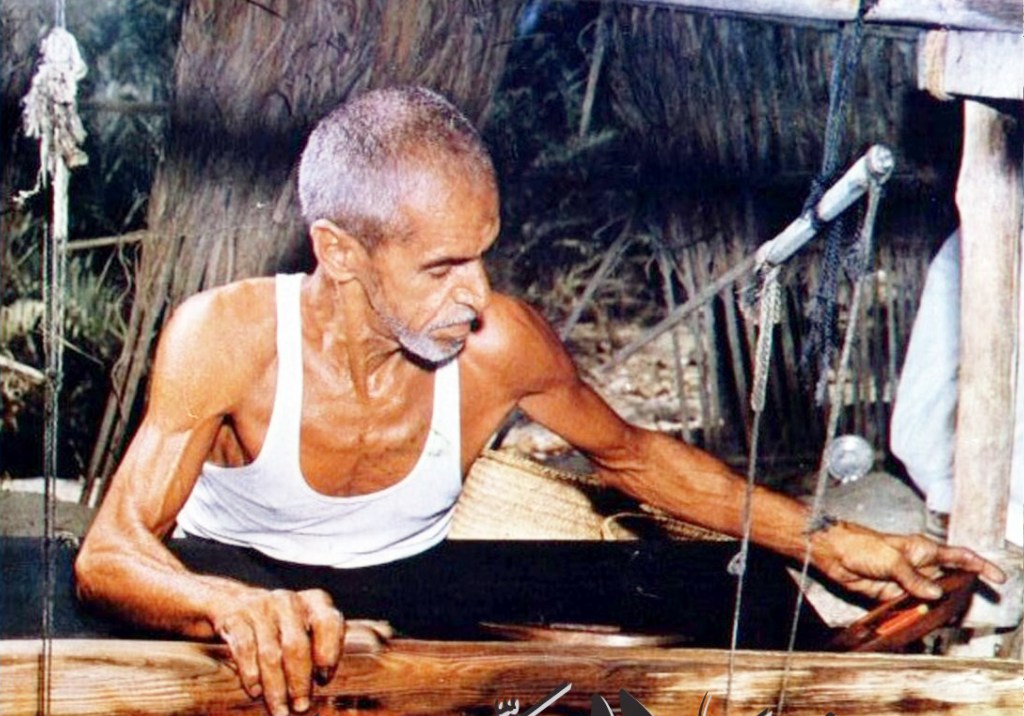
Meanwhile, Ali’s family moved insecurely between southern Iraq and southwestern Iran. At one time, they lived together with Muhammad bin Salman, another migrant from the village, who fled after fidawis accused him of stealing the lord’s falcon. Their evidence was that a feather of the missing bird had been spotted on the roof of his weaver’s workshop. With the threat of violence above his head, he took his family northwards. Muhammad is also my ancestor, as his daughter married Ali’s son Atiyya. The couple married in Iraq and were my Granny Zahra’s paternal grandparents. (Post-Publication addition: Atiyya bin Ali would go on to become one of the greatest poets of the Baharna dialect)
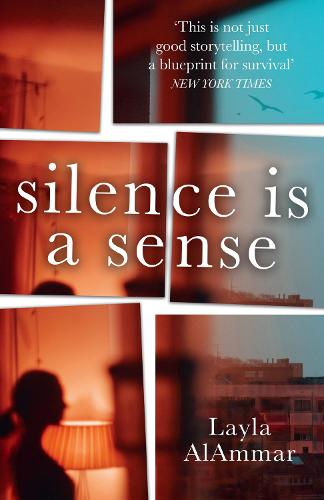
Silence is a Sense is a 2021 book by Layla AlAmmar. Above: Book cover, showing the figure of a woman looking out from a dim room to the world outside.
I: Fear and Expression
Let me begin with a quotation, not from the book I’m about to consider but from another it called to my mind:
In the fearful years of the Yezhov terror I spent seventeen months in prison queues in Leningrad. One day somebody ‘identified’ me. Beside me, in the queue, there was a woman with blue lips. She had, of course, never heard of me; but she suddenly came out of that trance so common to us all and whispered in my ear (everybody spoke in whispers there): ‘Can you describe this?’ And I said: ‘Yes, I can.’ And then something like the shadow of a smile crossed what had once been her face. – 1 April 1957, Leningrad. (From Requiem by Anna Akhmatova)
The conceptual duality of fear and expression seems to be rare in Western fiction. I don’t think the West really understands what true fear is (with the obvious note that, through imperialism, the West has usually been the perpetrator of fear). On an individual level, it is certainly understood: for example, the fears of the abuse victim is certainly present in literature and media. But the fear and expression (or lack thereof) of a whole community and society? And the impact that has on the psyche, the terrible physicality of silence and its effect on one’s sense of personhood? That is the domain of Eastern literatures.
Perhaps that is why I felt drawn to Akhmatova’s Requiem as I wrote this. Soviet-era Eastern European literature and Arabic literature often feel like siblings to my mind and so there is no strange stretch that Akhmatova should be one of the first connections I make with the book. The introduction to my copy, by translator D.M. Thomas, notes: From 1935-40, the period of its composition, to 1957, it is said to have survived only in the memories of the poet and a few of her most trusted friends. It was first published in 1963, ‘without the author’s knowledge or consent’, by the Society of Russian Émigré Writers, from a copy which had found its way to the West. The idea that the poem existed secretly for nearly thirty years, and that it was first published by looser-lipped exiles in the West, feels strikingly relevant.
I see fear and expression as the duality here. Not fear and bravery, nor silence and expression. When we express ourselves, we triumph over fear, at least in the moment (be it a speech, a novel, an unfurled banner). When we hold ourselves in silence, we are beholden to fear. Sometimes, I wonder at the things people say in the UK, wondering what it is like not to feel the clamping power of fear on a loose tongue.
Thus I felt drawn to Silence is a Sense from my very first encounter with its title and how it seems to immediately evoke a certain lived experience, that of the duality of fear and expression.
In fact, my own sensibilities seem confirmed by an article by the author, who writes on LitHub: We write of the pain and bear witness to trauma that resurfaces and plagues us. We write knowing how futile it is. We write to keep alive a grief that refuses consolation. We write in anticipation of decades to come when new revolutions will spring into being in response to the very same injustices.
II: Violence and Community
Silence is a Sense is the second book by Kuwaiti novelist Layla AlAmmar and follows an unnamed narrator as she navigates her life in the UK. Our protagonist is a Syrian refugee whose trauma has rendered her incapable of speech. She lives in an estate formed of two tower blocks that face each other and she watches the secret and not-so-secret lives of the denizens of these tower blocks and their surrounds. Among them are the Juicer; No-Lights-Man; Chloe and Helen who live with abusive Dad and their brother Matt; Hassan, the proprietor of the local corner shop; Imam Abdulrahman in charge of the local mosque; and there are many more besides. The book elegantly moves between her observations of life around her, her memories and nightmares, and her articles for an online magazine under the penname The Voiceless.
Though there are many people living in these tower blocks, and though they live ostensibly in peace – our narrator reflects on the rainy sky and the absence of bombs falling – they live without a sense community.
This contrasts with the narrator’s memories of Aleppo. There, a sense of community is torn asunder through war’s violence. Over the course of the revolutionary moment-turned-civil war, clear friends and family members turn into shadows of their former selves, the edges of their personalities frayed, as war brings each of them to their individual limits.
If the narrator’s Syria is a land where community is ripped apart by violence, then Britain is a land where violence gives cause for a community to stitch together. The violent isolationism practiced by the tower block denizens forces them to band together as individual and communal violence reaches a crescendo. The narrator dismisses activists in Britain as playing a low stakes and naïve game, and while the stakes are perhaps lower, there is a sense gotten from her flashbacks to Syria that her friends there were just as naïve as the ones she makes in Britain.
These two dualities – community and individualism, war and peace – are at play constantly in the novel. There is no community in peaceful Britain – and yet, it is not so peaceful. Helen’s husband is a violent abuser who she hasn’t the strength to leave. Racist thugs come to disrupt celebrations at the local mosque. It is supposed to be safe in the UK, and yet the constant trickle of not-so-petty crimes and personal violence swirls the protagonist down the whirlpool of her own troubled psyche.
III: The Voyeurism of the West
All the while, the narrator writes her column, The Voiceless, seemingly to stabilise herself. These Voiceless essays, peppered throughout the novel, provide stability for the reader too, giving us something familiar to read in her op-eds, more concrete than the journeys within her mind’s eye (more on that later), where reality can give way to dreams and traumas from one sentence to the next.
But who benefits from reading The Voiceless and her anonymous opinions? Josie, the narrator’s editor at the magazine, is constantly fishing for her ‘true’ story. At first the narrator avoids giving anything away, but when she relents and provides stories of her journeys through Europe, Josie flinches – her stories sound fictionalised, unbelievable, untrue. No one person could have experienced so many daily horrors. The more the narrator tries to appease the Western gaze, the more she herself encounters the violence of racism.
This relationship between the narrator and Josie brings out the crucial dichotomy of fear and expression. The more the narrator expresses herself through her column, the more Josie tries to control her speech. Gentle editorial nudges become appeals for the narrator’s ‘Journey’, become critiques of her portrayal of her own life. By the end, Josie is encouraging the narrator to use fiction as a vehicle to tell her own story. We are left to wonder: is she encouraging the narrator to use her voice to its fullest potential, through the medium of fiction, or is she trying to mould a refugee’s voice to be palatable for a British audience?
That question leads to another: who is the audience of the Voiceless? The narrator expresses herself through her articles because she needs the valve of expression. But her British audience is full of people who judge, ridicule, question, attack and dismiss her. She fears giving too much of herself away, in case family – wherever they may be – might somehow identify her.
More subtly, the novel seems to ask: to whom does a refugee’s story belong to, and what do they owe to explain to their audience? Does a refugee owe an audience anything at all? Does this refugee on your page owe you, the reader, anything?The narrator’s personal history is hemmed by the constant violence, illness, fear, cold and abuse she suffered. She does not want to unearth it, yet the constant requests of Josie, and triggers of traumatic memories around her, unlock memories of that journey.
These are memories she clearly does not want to share. So the beginnings of her life in Syria – which is a curiosity for the reader who naturally wishes to understand the protagonist – make uncomfortable reading the further we continue. The deeper into the book we go, the more we become privy to the narrator’s private thoughts and memories. In some of the most vividly realised nightmare segments, she and her friends are conducting their civil activism in a disintegrating flat. From the corner of one ceiling, a human eye watches them, constantly, like flesh-and-blood CCTV; at one stage, they even attempt to knock it down. The eye is a straightforward metaphor of Assad regime, its spies and its autocrat’s face plastered everywhere bearing down on activists. But on another level, I think the eye is us, the reader. We have infiltrated the narrator’s head, have invasively become her mind’s eye, and even in her sleep she cannot escape us reading on, demanding to unravel her mysteries with every next word read. Knowing the pain she suffers because people paint her by the labels of ‘Syrian’, ‘Arab’, ‘Muslim’ and ‘refugee’, the reader becomes an accomplice in peeling away her layers against her will.
In creating this discomfort, the book seems to hold a knife up to the voyeurism of so many readers who approach refugee narratives. Because there is nothing romantic about walking half the earth in search of safety. Anyone who knows a refugee, is a refugee, or has worked closely with them is familiar with that voyeurism. It is the white, middle-class mother who weeps at the screening of a film on their Plight and asks, “What can we do?” It is the journalist whose opening question to an unprepared teenager is, “What was it like to go on your Journey?” It is the exasperated liberal who sighs, “We welcomed them in, what more do they want?”
If the grotesque in fiction is often used to reflect societal ills, then here it is used to hold a mirror up to that voyeurism. As we enter the increasingly uncomfortable depths of the narrator’s psyche and bear witness to her traumas, nightmares and losses, the book seems to be addressing the voyeur: there’s nothing here for you, and there’s nothing to make you feel good about yourself.
Some of the characters in the novel seem to be that same kind of voyeur. They are complex individuals, and their goodness is not dismissed. Our narrator is flawed and requires these people’s goodness to grow. In the beginning, she sits outside society and largely rejects it. She is quietly judgemental and slow to action. Whether in present moments of conflict or in the remembered past of Syria, she is usually a passive bystander. Overcoming that passivity as the violence escalates around her becomes an imperative towards the end of the novel.
The people of the tower blocks are also flawed. Even as friendships develop with No-Lights-Man and Josie, I am left with a nagging fear for our narrator by the end, as these new friends reveal their own voyeuristic and flat perspectives of her, each in their own way. Do they actually see her as a complete human? It’s possible they do not: but their interactions with each other make everyone, from the narrator to those she grows closest to, fuller people.
Ultimately, my mind keeps returning to this voyeurism. My paperback copy includes a quote by the New York Times on its front cover: “This is not just good storytelling, but a blueprint for survival.” Perhaps this is unfair – the full review may provide valuable context – but it rather feels to me that this phrase, ‘a blueprint for survival’, is exactly the sort of voyeurism in refugee lives that the book turns on its head. Like Josie’s pressured editorial notes to the narrator, it speaks to the intoxication those of us living safe lives seek in the lived experience of the oppressed.
IV: Empathy and Appropriation
While the narrator finds herself in conflict with the Western gaze, AlAmmar as an Arab writing in the English language seems to elegantly deflect it. It feels like a book written for an Arab readership in English, not for a Western one. The metaphoric language is Arabic in character and flows effortlessly: “I swallow down the panic but my heart is a small, angry bird fluttering in my chest”; “My mind folds in on itself, like origami”; “all those eyes picking me apart like vultures”. References to jinn hanging from lampposts and malak almawt are never exposited for us: either you get it or you are trusted to do your own research.
As I approached the end of the novel and my reflections on voyeurism took shape, I found myself asking the next logical question: does AlAmmar have a ‘right’ to tell this story? AlAmmar is not a Syrian, nor a refugee. They are adjacent: a Kuwaiti women whose proximity in language and culture allows her to extrapolate and tell this story.
But is that enough license to tell such stories, or do they belong only to those with lived experiences? Are Syrians the only ones who should tell stories of Syrians?
An answer begins to form when we read the Acknowledgements, which ends on this note: “I must extend a special thank you to Faraj, a young man from Aleppo, who, on a beautiful Sunday in Hampstead Heath, shared his story with an unflinching bravery and honesty. The joy, love, and hope with which you approach the world, despite all you’ve seen, is as great a testament as any to the resilience of the human spirit.”
Another piece of the answer is provided in AlAmmar’s article for LitHub, which makes her awareness of this dilemma quite clear: “it was imperative to maintain a critical distance between feeling for someone and feeling as someone, even as I asked myself whether literature could be written from such a position. Writing demands empathy as much as observation: How can you awaken feelings in the reader if you haven’t stirred them in yourself? And yet, there’s a responsibility there, to resist slipping into the appropriation of someone else’s pain.”
So does the novel appropriate another’s pain? The reader (or at least, this reader) is forced to address the voyeurism built into ‘Refugee’ genres of literature. Perhaps it’s because this struggle between empathy and appropriation (another duality?) was present in the author’s process that the book feels like a critique on voyeurism. In the hands of a different (probably Western) writer, Silence is a Sense would be a shockingly touristic vision of a Syrian’s life.
But I think this is not a ‘Refugee’ novel but an ‘Arab Spring’ novel. I found this idea confirmed by the author’s LitHub article (already referenced, and which names the Arab Spring in its title). Its position there is its strength, and its avenue of escape from being an act of appropriation. The experience of the Arab Spring, particularly in its most passionate early days, knocked down national identities invented by colonisers and came closer to realising a pan-Arab experience than anything since the mid-century anti-colonial movements.
While AlAmmar’s novel inhabits a specifically Syrian experience, the story exists within a broader Arab and West Asian experience: that of individuals and communities navigating between fear and expression. It is written from that deeper lived experience. Well-researched, and AlAmmar’s real-life inspirations acknowledged and thanked, the story never descends into exhibitionism or voyeurism. Instead, it emerges as a powerful reflection of the post-2011 Arab and West Asian experience. Silence is a Sense is fundamentally a novel about how authoritarianism corrodes our sense of self, both on an individual and communal level, and the violence that enacts on our ability to express ourselves. It does not claim that expression and community can negate the degrading impact of fear and violence – that would be far too neat – but it does powerfully claim that they can combat the effects.
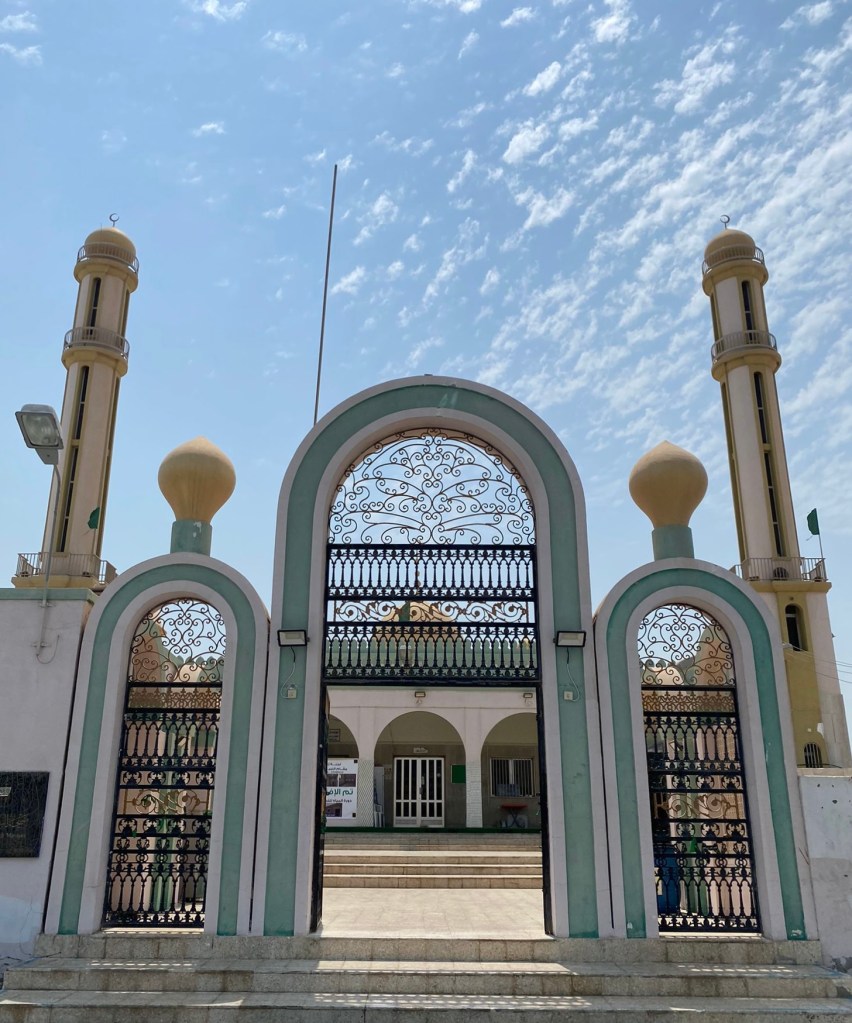
I visited Bahrain for the first time in too many years this summer. On one day, we did a tour of historic mosques in the islands, visiting the resting places of Sheikh Maytham Al-Bahrani (Mahooz), Emir Zaid bin Sohan (Malchiyya), Sheikh Ahmed bin Sa’ada Al-Sitri Al-Bahrani (Sitra) and of course the Nabih Saleh. Each of those places and persons deserve their own story.
At Nabih Saleh, which is located on the island by the same name, we were lucky to meet the caretaker of the mosque. He gave us a tour of the place, its historic graves and the rock they were carved into and, most preciously, this little booklet: The Story of Nabih Saleh.
The booklet is intended as something of a visitor’s guide for the mosque and the shrine of Nabih Saleh. It was written in 1987 by Muhammad Ali Al-Nasiri (1919-1999). If you follow me on Instagram, you might know that I talk a lot about Al-Nasiri, who I consider to be one of the most important literary figures of 20th century Bahrain. Muhammad Ali Al-Nasiri was a Mullah (in Bahraini context a preacher, particularly around the stories of Ahlulbayt) and a poet. He was a student of Mullah Atiyya bin Ali Al-Jamri, my great-great-grandfather and one of the great religious poets of the Baharna, who popularised a form of dialect poetry that is still popularly recited today during religious events, particularly during Muharram and the ten days of mourning around Ashura.
It is for his work documenting culture that Al-Nasiri remains an essential literary figure. Last year’s issue of ArabLit Quarterly: FOLK featured his work, as both myself (“Waddle Like a Duck”) and Rawan Maki (“Wat Rainbow”) depended on his books collecting Bahrani folk poetry for our translations and articles. Al-Nasiri has books documenting Bahrain’s culture, folk poetry, jokes, colloquial sayings and more. And as a religious poet, we see him in many places. On the day of our tour, we first encountered a poem of Al-Nasiri that hangs above the shrine of Sheikh Maytham Al-Bahrani, and then bumped into him again in the shrine of Nabih Saleh. It is his great love and celebration of Bahraini and Bahrani culture that makes him so important twenty years on.
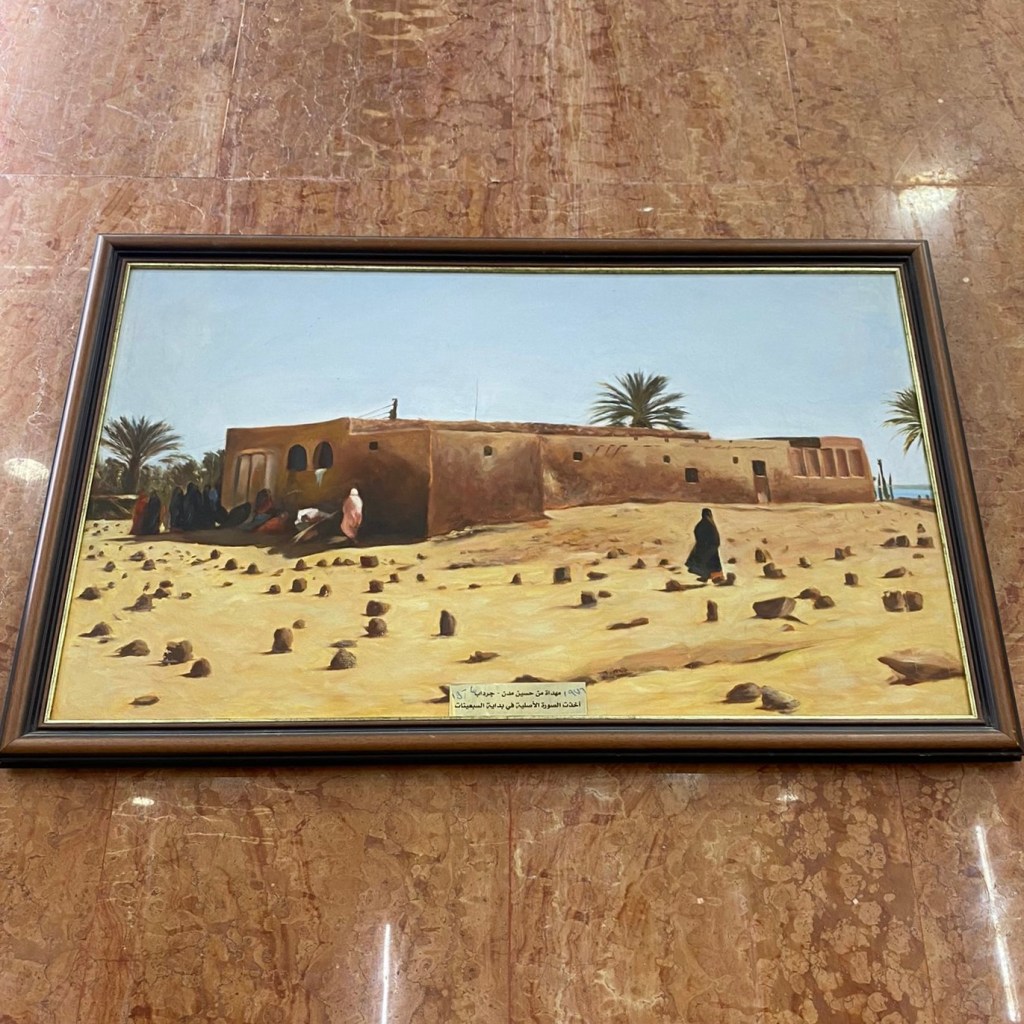
A painting of the old shrine prior to its renewal in the 1980s hangs inside the mosque
Nabih Saleh is a significant religious site for Bahrain. It was once on a secluded island just north of Sitra island and east of the main Bahrain island (Awal), though land reclamation has made it all one contiguous area. Until about 50 years ago, you could only reach Nabih Saleh by boat. There is little here except for the shrine. Back in the day, there was also a date grove and sales of its produce was used to maintain the ship that took pilgrims across. It was particularly an important site for female pilgrims as well. People would travel from far to have their prayers enhanced and fulfilled in this shrine. Tragedy has struck Nabih Saleh: in the 1940s, an overcrowded boat full of women and children capsized in the short journey to the island, with virtually no survivors. That event is recorded in a mournful poem by Mulla Atiyya, in which the poet demands answers from the sea, the wind and the ship captain for the avoidable tragedy – one which I hope to translate one day.
Pilgrims still attend to this day, and what is striking is how many of them are also non-Muslims – when we visited, there were two Hindu men respectfully attending the shrine, and people of all faiths frequently journey to pay respects to Nabih Saleh.
On the request of the shrine’s caretaker, Husain Al-Basri, I have translated the first two sections of Al-Nasiri’s booklet. The original text is longer than mine, as it includes two poems, some descriptions of other notable graves, and details on the shrine’s construction. But this is the juicy part.
Read on to discover the story of Nabih Saleh and the man it was named after.
It feels like a very long time since any posts have come up here – and indeed, it’s because it has been. It’s been an incredibly busy year. I’ve completed my first year of teacher training (got my QTS, but one more year to go for the PGDE on the track I’ve chosen). Somehow, I have managed to keep afloat with my poetry and writing. I’ve not done much standard publications because I haven’t had time to put myself out there – but I have been lucky in many ways. A new role for the city of Manchester has allowed me to pursue my passion for multilingualism that cuts across all my recent work.
Please note: I keep my About page regularly updated with all my publications as both a writer and a translator (though I don’t typically list all the workshops and events I host or participate in).
Manchester Multilingual City Poet
In February, I was appointed as one of the 3 inaugural Multilingual City Poets of Manchester, working in both English and Arabic and alongside Anjum Malik and Jova Bagioli Reyes.
I should have made a bigger fuss about it than I have! This has been a lucky and amazing break. It is an honour to represent the city in this way, and to bring to it both my languages, mother tongue and other tongue. I’ve done several things as part of this – Al-Usra wal–Sufra, which I’ll get around to beneath, a key part amongst them.
Our City Poet roles were announced on the 17th February – a hectic day, given I was teaching and had to leave my school early to rush to the Manchester Poetry Library.
You can watch my poem for the city, In Prisms of Knowledge, on YouTube:
The Arabic version, Fi Noori Bayt al-Hikma, is ready and will be published soon.
As part of my work as City Poet, I’ve also translated and performed the Arabic version of Anjum Malik’s poem This Here, and will be doing the same for Jova’s poem later in 2022.
Al-Usra wal-Sufra at the Liverpool Arab Arts Festival
On 17 July, my art exhibition Al-Usra wal-Sufra featured on the last day of LAAF, at the Family Day festivities in Sefton Park. You can see pictures from the event here.
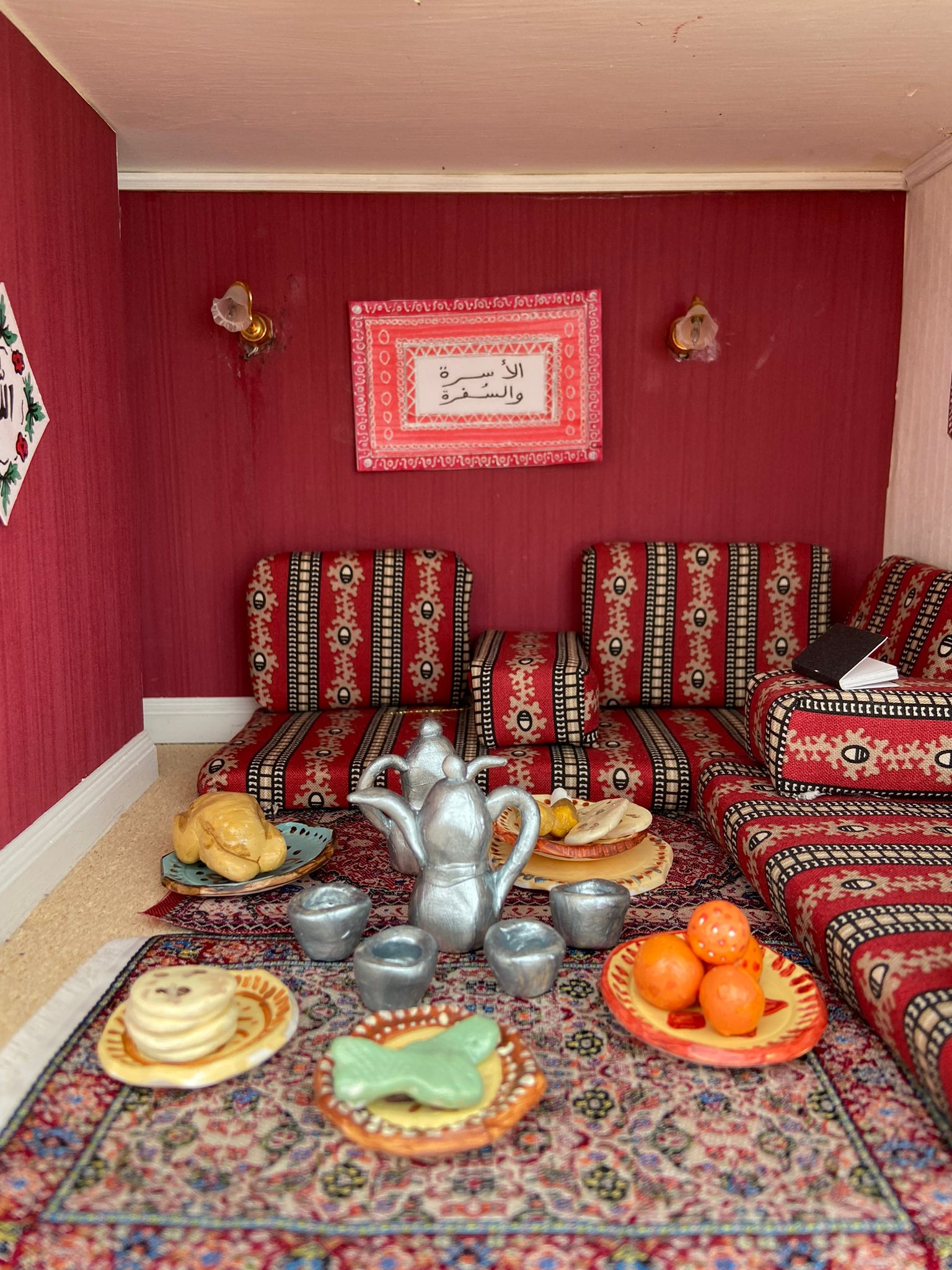
Al-Usra wal-Sufra, or Family and Feasts, was an attempt to bridge the language gap British Arab children face. I conducted workshops in two Arabic schools – the Manchester Arabic School and the Liverpool Arabic Centre. We played games with our language, enjoyed our dialects, and read the poem Good Morning Tea by Jawdat Fakhreddine, translated by myself:
We make good company with tea: Greet morn with it, for that’s our way, For tea must come up with the sun, Just as the night’s tail drags away, We meet with morn, all’s said and done, Then part our ways for all the day.
The children wrote their own poems inspired by this, and the results were astounding! We wrote about food close to our nationalities, and the students wrote about maqlooba, mendi, koshari, aseed, baklawa, coffee and so much more.
These poems were displayed alongside a doll house which was made with local multidisciplinary artist Rosie Stanley to resemble a typical British Arab household, complete with a majlis where all the family and friends may gather for big weekend meals.
Inspired by the pupils, I wrote the following poem:
الأسرة والسُفرة مقلوبة سيدو تقلِّبُ قلوباً فلسطينية ومندي حبابة يولِّعُ عواطفاً يمنية سمكة جِدَّة تقرِّبُ سواحلاً جزائرية وكشري تيتا يفوِّقُ عجائباً مصرية صالونة أمي العودة تلألِئ بحوراً بحرينية وجدتي، كجدتك، جدة بلا مقارنة
كما نرحب القمر بقهوة المساء كما نلتقي الشمس بشاي الصباح لهجاتنا المختلفة بهارات ألسنتنا عند السُفرة نستهلك قصص أصولنا
استلهمت القصيدة من حاتم، طالب في مدرسة مانشستر العربية، وقصيدته “مقلوبة تقلب القلب”.
Al-Usra wal-Sufra: Family and Feasts
As Sido’s maqlooba spins hearts Filistini And Habaaba’s mendi fires passions Yemeni As Jida’s grilled fish recreates coastlines Jaza’iri And Teta’s koshari eclipses ancient wonders Masri As Ummi al-Auda’s saloona sends me to seas Bahraini And mine, like yours, is the world’s greatest granny
As evening coffee meets the moonlit night And morning tea greets the dawning sun As dialects reflect our Arabic varieties spiced The feast on the sufra is our flavour of home
Inspired by Hatem, a Manchester Arabic School student and their poem ‘maqlooba tuqallub al-qalb’
Events, Workshops and Multilingualism
Multilingualism and translation really have been at the heart of what I’ve done:
January: A consultation with Young Identity and Manchester Poetry Library for an Over 26 poetry group which we are still working towards doing – this is something that we hope to be fully funded when it becomes a reality.
January: ArabLit Quartlery, FOLK launch event! Hard to believe that was so long ago now but yes, it featured presentations, excerpts, conversations and more. Check it out below.
February: I translated the opening of Ghazi Al-Haddad’s beautiful praise poem for Imam Ali, Are You The Moon Itself? Published in time for the Mawlid of Imam Ali.
March: Mother Tongue Other Tongue 2022 Launch Event with Manchester Metropolitan University.
March: Stephen Spender Trust CPD alongside Nisah Sajawal on doing translation workshops in the English classroom. This blended my school work and poetry work in a wonderful way.
March: In this time I was also a reader for New Writing North’s annual Northern Writers Awards, reading collections for the two poetry competitions and selecting towards the judges – a valuable insight into this process.
May: With Young Identity and Manchester Poetry Library again, I co-hosted a workshop with the masterful Anthony Joseph, who brought surrealism to our writing.
June: Performance at the 1st Street Festival with Young Identity.
June: Also published a short translation in ArabLit Quarterly: THE JOKE! You can see it here.
July: Two events at the Shared Futures conference for English teaching – one in a performance with Young Identity, the other in a panel with the City Poets.



 Islander's Oasis