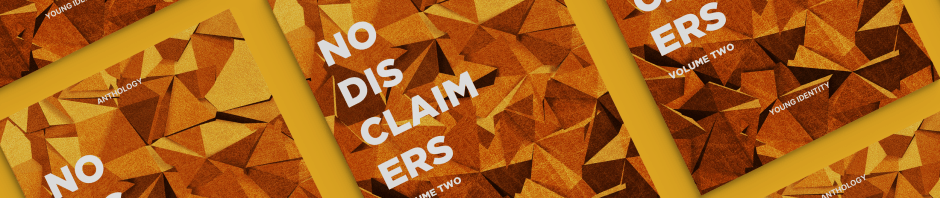

Young Identity’s latest collection is out: No Disclaimers Volume 2. I’m in it, and you can buy it here: https://www.youngidentity.org/shop
YI’s book features two of my poems. Asked for poems about loss, I submitted two related to my the losing my grandfathers. The first one, Now Loading, is about my own personal experience when my grandfather Sheikh Abdulamir Al-Jamri died in December 2006. I was 15 and a useless ancillary in the family grief of his funeral. My grandfather’s funeral was probably the largest single funeral in recent memory in Bahrain. He had been the leading figure in the 1990s struggle for democracy, and a uniting force who was respected across society, from the religious, secular, and governmental sections. Everyone turned out to pay their respects, and his death was as much a national event as a family one. Understandably, perhaps, my own individual sorrow was lost in the wider picture. The poem does not do justice for him or his legacy – but it doesn’t set out to, really. It is about me, stuck at home, dealing with my own loss, trying to lose myself in the world of The Elder Scrolls IV: Oblivion – a game whose plot is spurred by the death of an emperor. Our computer was outdated and could barely run it, and in between every town, dungeon and field, the long loading times forced me to consider what I was trying to close myself from.
The second poem, In the Footsteps of my Forebears, is a love letter to my maternal family’s home of Jidhafs. Due to many reasons, the pandemic amongst them, I went many years without visiting Bahrain. In that time, I grew a lot; came to understand and value family and personal histories more, in that way I think happens to a lot of people as we move from our 20s into our 30s. Now older and wiser, I was eager to spend time with my grandfather. But, in 2022, three days before I was due to visit, my grandfather Hajji Saleh Al-Qassab suffered a stroke. He passed away shortly after I returned to the UK. I’m glad that I was able to spend time with him in hospital, but sorrowful for all the lost opportunity. One of my fondest childhood memories of him was accompanying him to the Al-Musharraf mosque in Jidhafs, and it’s around that memory, and my own changing perceptions of Jidhafs and Bahrain (Awal), that this poem is borne from. And, in placing myself in Jidhafs and letting its rich history breathe through my pen, I was able to spend time with my grandfather in a way that life’s course prevented.
Now Loading
My world is cloistered in the inches of a CRT. Blue.
A cell, a tunnel, a hope: Tamriel. Then, the emperor
has fallen. His voice releases me of a history I have
not yet grasped. His Picard intonations, so unlike
the gasping of a stroke, spittle foaming like the waves
washing the feet of Abu Subh beach.
Tip: Save often. The Planes of Oblivion are a dangerous realm.
My world is Tamriel, cloistered blue
in a cell. The inches of the past, a tunnelling voice,
so unlike the feet that wash Abu Subh beach, foaming,
intoning, his Picard spittle spraying over waves, I gasp
for release, the emperor has fallen, grasping the CRT’s hope.
The avatar fumbles for the quickload. Not yet.
Tip: Your agility affects how often you are staggered or knocked back.
Considering how it rained, flooded, rained. I do not have a quicksave
or a compass. Like the avatar following the emperor down hope’s tunnel,
I never questioned your wisdom until it was gone. How obvious now,
the pathetic fallacy. Past Saar, a procession down a cathartic path
autosaves. Filling the grave, washing the feet that fill the yard.
Tip: Beware, the death of the dreamer means the death of those who share his dream.
Abu Jameel lies in a save state I cannot reload. I did not
enter Tamriel until I knew hope was gone. How pathetic. That night,
washing past Saar, a procession arrives at the yard. The grave, filling,
rain beats the avatar following the emperor down. A tunnel is
filled. Intonations foam blue. The voice, a past I must now know. I release
a gasp. Foaming with the washing of the feet. Flooding blue. Grasping:
He died at 4.30 AM, 18-12-06.
My processor churns a loading screen,
stuck.
In the Footsteps of My Forebears
In memory of my grandfather Hajji Saleh Mahdi Al-Qassab, who passed away on 18 August 2022 before I could share this poem with him.
I: The Grandson
Following in your footsteps,
my little feet catch,
under the scuffed leather of my sandals,
the dust kicked up along your winding path:
across the road where pick-ups cough,
up little hills, down narrow ways
and past a thin cat’s hiss
to where the market meets
the lingering smell of fish.
Along this road, grey and beige,
looms Al-Musharraf,
glimmering green and draped in black,
there we wash, there we pray,
there you find your bliss.
I sit in the radiance of your voice
and hearing the words you say,
I sense a deeper love in them,
wonder what their meaning is.
The grandson sits at one end of the hall,
his grandfather along the opposite wall.
At his place just by the minbar,
he sits and opens his book to read
and as he adjusts the mic, he thinks
of all the sights this little boy’s eyes have missed.
II: The Grandfather
My feet still weave us through
the gardens, orchards and the springs,
up the hill (twice flattened now), then
down black curbs again,
to sink in earth that feed date palms
from whose tall necks the birdsong streams.
Go up the bustling market path:
it’s where Awal’s patchwork wove
to barter by the water flows
that fed our town’s fruitful groves—
—And from the square, the jam’i looms!
When we enter Al-Musharraf,
I wish that I could tell you, child,
the many things you’ve missed.
I take my seat to read the Karbala epic
and hope that through my intoned voice
you’ll glimpse Jidhafs as I recall,
as it, to me, still is.
The grandfather grows in the town he knows,
his grandson leaves for the end of the globe.
By the time he knows to love this path,
it’s by himself that he must go.
III: The Grandson
My grown-up feet follow the prints
of you who came before,
past Luza’s graves and Imam’s too,
to the Madrasa of Sheikh Dawood
where I still see the Dilmun Stone
that Victorian men passing through
nicked from beneath its descendants’ feet.
The winding path leads me into Fareeg Sultani
where the men of state once built their homes
made safe and strong with seradeeb,
the basements which, in times of war,
would prove our people’s sanctuaries.
I crane my neck to view the hills
that shade the children in the springs,
their laughter splashing like a lute,
the background to the market’s buzz!
There’s the spot your Baba Mahdi
sat and ground and brewed coffee,
where for the price of just 5 fils
you’d learn this at our forebears’ feet:
How Jidhafs was the beating heart
from where Awal’s arteries spread
to feed the people’s souls and trees
and made this land of countless palms
a Garden of Eden.
Along the path and up the steps,
in hallowed Al-Musharraf,
my footsteps sprout these memories
nourished by your sonorous voice,
such that the tapestries, black and green,
remind us not of Karbala’s epic
but of Jidhafs, your town as once it was,
where ‘was’, so vividly remembered, still ‘is’.


